
Hire Full Stack, React & PHP Developers — ANS RPO Guide
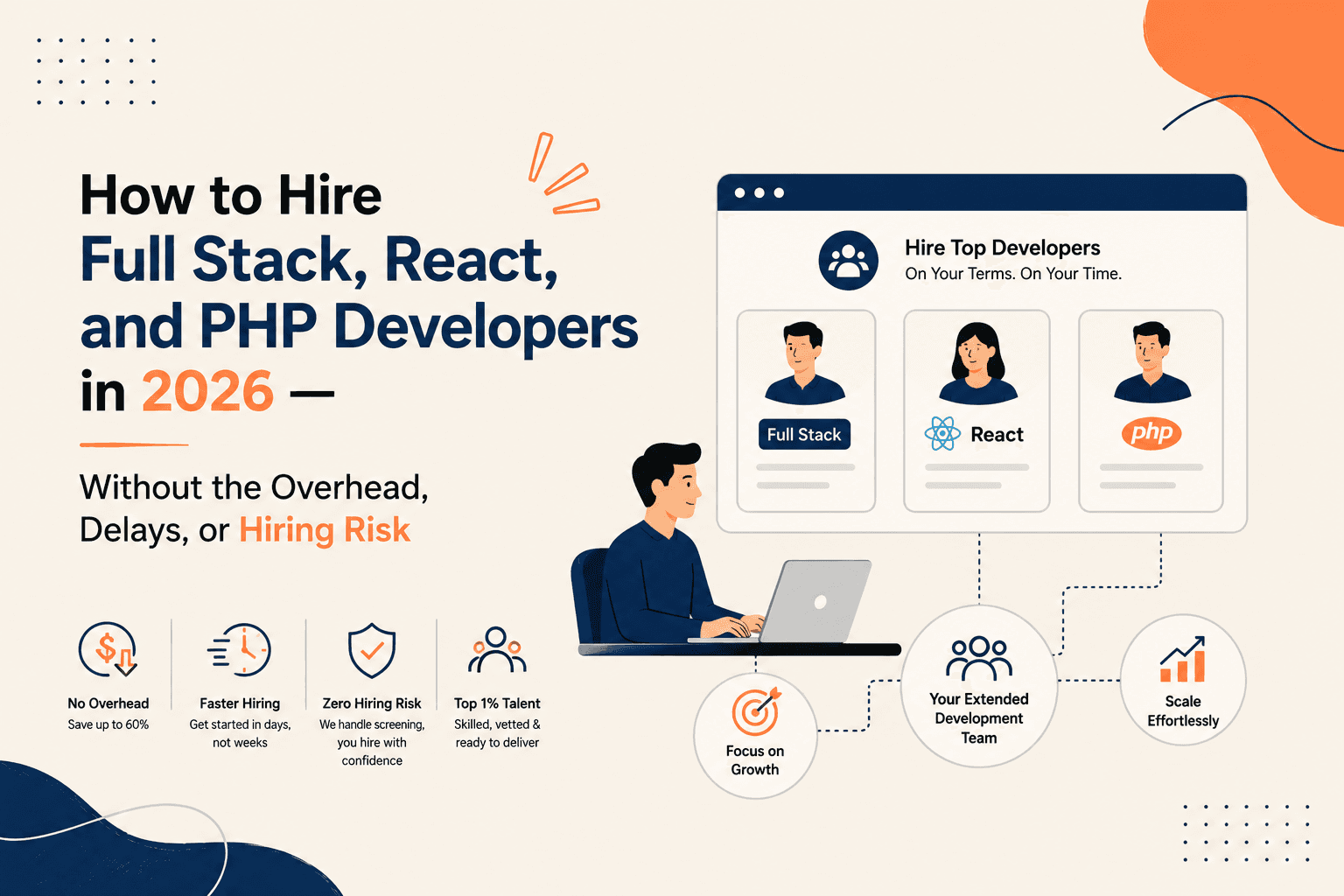
How to Hire Full Stack, React, and PHP Developers in 2026 — Without the Overhead, Delays, or Hiring Risk
The tech talent shortage isn't getting easier. Hiring timelines are stretching to 60–90 days, salary expectations are climbing, and the cost of a bad developer hire — in lost time, rework, and team disruption — can run into six figures. In 2026, the businesses outpacing their competition aren't the ones with the biggest hiring budgets. They're the ones with smarter hiring strategies. Here's what that looks like when you need to hire full stack, React, or PHP developers without the traditional friction.
The Developer Hiring Problem Most Businesses Underestimate
When a business decides it needs to hire a full stack developer, the instinct is to post a job listing, screen CVs, run three rounds of interviews, and wait. This process takes an average of 6–10 weeks in competitive markets — and that's before onboarding, ramp-up time, and the inevitable discovery that the candidate's stated skills don't fully match their demonstrated output.
The hidden costs compound quickly. Internal recruiter time, technical assessment hours from your existing dev team, delayed project timelines, and the salary premium required to close candidates in a competitive market — all of this adds up to a cost-per-hire that most businesses significantly underestimate when they budget for developer headcount.
The alternative is not just faster — it's structurally better. Offshore RPO-led developer staffing through a partner like ANS RPO eliminates most of this friction: pre-vetted, bench-ready developers across every major stack, deployable in 2–3 days, at 40–60% of the cost of equivalent local hires. Same output quality. Dramatically lower total cost and time-to-productivity.
Why Hire a Full Stack Developer — And What to Actually Look For
The decision to hire a full stack developer is often driven by a desire for versatility — one developer who can own both frontend and backend, reducing handoff friction and communication overhead in lean product teams. In the right context, a skilled full stack developer is one of the highest-leverage hires a growing business can make.
But versatility without depth is a trap. The best full stack developers bring genuine proficiency in both layers — not just surface-level familiarity with frontend frameworks and a working knowledge of REST APIs. When you hire a full stack developer, the technical bar should include:
Frontend proficiency — React, Next.js, or Vue.js with component-level architecture experience
Backend competence — Node.js, Python, PHP, or Java with database design and API development skills
DevOps awareness — Git workflows, CI/CD pipelines, basic cloud deployment (AWS, GCP, or Azure)
Security fundamentals — input validation, authentication flows, OWASP awareness
System design thinking — ability to architect features, not just implement tickets
Full stack developers who meet this bar are genuinely rare in the local market — and considerably more accessible through offshore talent pools where specialization and volume of production experience are high. ANS RPO's bench of full stack developers covers React, Next.js, Node, Python, and PHP stacks — pre-screened against exactly these criteria.
When to Hire React Developers — And Why Specialization Wins
React has firmly established itself as the dominant frontend framework for product-focused companies in 2026. When your roadmap includes a complex SPA, a high-performance customer-facing interface, or a component-driven design system, the right call is to hire React developers who live in the React ecosystem — not full stack generalists who use React occasionally.
Specialized React developers write cleaner component architectures, implement performance optimizations (memoization, code splitting, lazy loading) that generalists often skip, and bring familiarity with the broader React ecosystem — Redux, React Query, Zustand, Framer Motion, and the evolving Server Components model — that directly impacts product quality and maintainability.
The screening process when you hire React developers should go beyond "can they build a component." Evaluate candidates on state management architecture decisions, performance profiling methodology, accessibility implementation, and experience with testing frameworks like Jest and React Testing Library. These are the skills that separate React developers who ship maintainable products from those who ship code that works until it doesn't.
ANS RPO's React developer pool covers the full spectrum — from component developers to senior engineers capable of architecting micro-frontend systems and leading frontend teams. Whether you need one React developer for a product sprint or a dedicated frontend pod, the engagement model flexes to your requirement.
Why Businesses Still Hire PHP Developers — And When It's the Right Call
PHP's staying power surprises people who've written it off as a legacy technology. In 2026, PHP powers over 75% of websites with a known server-side language — including platforms like WordPress, Magento, and Laravel-based SaaS applications that process billions of dollars in transactions annually. For businesses running on these platforms, the decision to hire PHP developers is not a concession to legacy — it's a practical, commercially sound choice.
Modern PHP development — PHP 8.x with Laravel or Symfony, typed properties, match expressions, fibers for async processing — is a genuinely capable and productive development environment. The developer quality gap between modern PHP and other backend languages has effectively closed. What matters is the developer's proficiency, architecture awareness, and production experience — not the language.
When you hire PHP developers for Laravel-based applications, Magento customizations, or WordPress platform development, the screening criteria should include MVC architecture fluency, ORM proficiency (Eloquent or Doctrine), REST and GraphQL API development experience, and a strong grasp of PHP 8.x features. Developers who are still writing procedural PHP without framework discipline are a different — and far riskier — hire.
Hire Full Stack Developer
Best for lean teams needing end-to-end ownership. Covers frontend + backend + basic DevOps in one resource.
Hire React Developers
Best for product teams building complex, high-performance user interfaces that need deep frontend specialization.
Hire PHP Developer
Best for Laravel SaaS, Magento, or WordPress platforms requiring modern PHP 8.x backend expertise.
The ANS RPO Advantage — Offshore Developer Talent, Bench-Ready in Days
ANS RPO has spent 14 years building offshore developer and recruitment capabilities that serve businesses across the US, UK, and Australia. The core promise is simple: when you need to hire a full stack developer, hire React developers, or hire PHP developers, you shouldn't have to wait 8 weeks and pay a local market premium to get it right.
ANS RPO's offshore developer model offers three structural advantages that traditional hiring simply cannot match. First, speed — developers are bench-ready and deployable in 2–3 days, not 2–3 months. Second, cost — offshore engagement models deliver 40–60% savings compared to equivalent local hires, without compromising on technical output quality. Third, flexibility — month-to-month engagement structures mean you can scale your dev team up for a product launch and right-size it afterward, without the legal and HR complexity of hiring and laying off permanent staff.
The technical vetting process ANS RPO applies before a developer reaches your team covers stack-specific proficiency, architecture thinking, code quality standards, and communication clarity — the four dimensions that determine whether a remote developer integrates productively into your team or becomes a management burden. Developers who make it through this process are not just technically capable — they're operationally ready to contribute from day one.
Choosing the Right Engagement Model for Your Developer Hire
Not every developer need is the same — and the engagement model should match the requirement. ANS RPO supports three primary models: dedicated full-time equivalent developers for ongoing product work, part-time developers for specific feature builds or maintenance requirements, and project-based engagements for defined deliverables with clear timelines. Each model carries the same pre-vetting standard and the same month-to-month flexibility that removes long-term commitment risk from the hiring decision.
In 2026, the ability to hire full stack developers, React specialists, and PHP developers quickly and cost-effectively is a genuine competitive advantage. Businesses that rely on traditional hiring pipelines for developer talent are accepting delays, premiums, and risk that offshore RPO-led staffing eliminates entirely. ANS RPO's bench-ready developer model — 14 years of offshore expertise, 2–3 day deployment, and up to 60% cost savings — is built precisely for businesses that need the right developer, at the right time, without the traditional overhead of getting there.