No Commitment Developer Hiring: A Complete Guide to Flexible Developer Recruitment
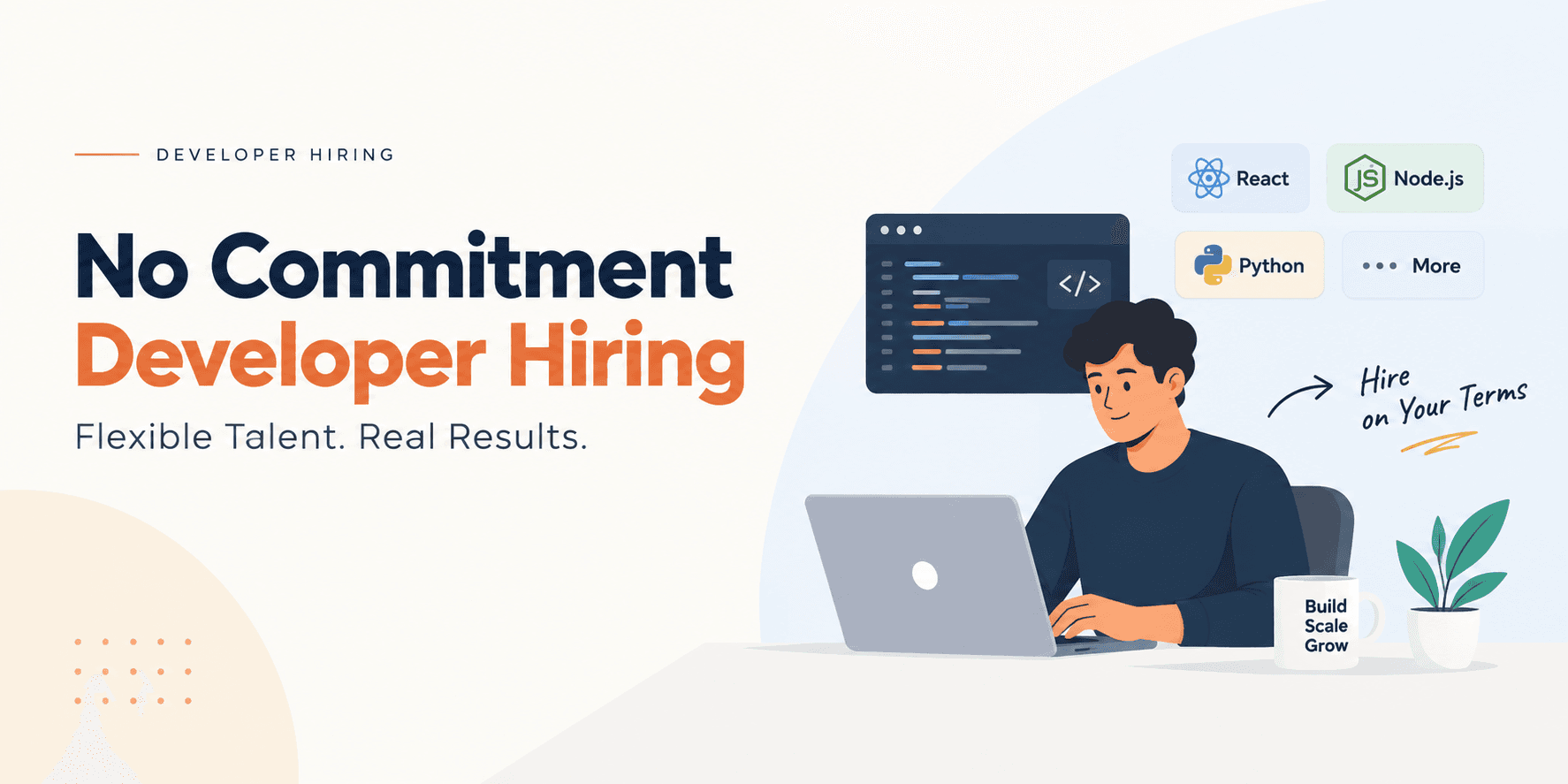
Businesses today need skilled developers, but not every project requires a long-term employment commitment. Product launches, MVP development, software upgrades, seasonal workloads, and technical backlogs can create short-term demand for specialized development talent.
No commitment developer hiring gives businesses a flexible way to access skilled developers without being tied to lengthy contracts or permanent hiring arrangements.
Instead of building a large internal engineering team, companies can engage developers according to their current project requirements, budget, timeline, and technical needs.
This guide explains how no commitment developer hiring works, its benefits, costs, suitable use cases, hiring process, and key factors to consider before choosing a flexible developer engagement model.
What Is No Commitment Developer Hiring?
No commitment developer hiring is a flexible hiring approach where a business engages a developer without entering into a long-term employment or development commitment.
Depending on the provider and engagement structure, businesses may be able to hire developers:
For a specific project
Month to month
Part time
Hourly
On demand
For a defined development milestone
For temporary technical support
For an MVP or product launch
For ongoing work with flexible continuation
The main idea is simple: hire the development expertise you need without committing to a longer engagement than your business requires.
For example, a startup may need a React developer for three months to build an MVP. Instead of hiring a permanent employee, the company can work with a flexible developer for the duration of the project.
Why Are Businesses Choosing No Commitment Developer Hiring?
Traditional hiring can involve lengthy recruitment processes, employment contracts, onboarding costs, benefits, infrastructure, and long-term salary commitments.
That structure can make sense for permanent roles, but it may not be suitable for every development requirement.
No commitment developer hiring provides an alternative for businesses that need flexibility.
Common reasons include:
1. Changing Project Requirements
Software projects can change rapidly.
A business may initially need a frontend developer but later require backend, DevOps, mobile, or AI expertise.
Flexible hiring makes it easier to adjust the development team as requirements evolve.
2. Short-Term Development Needs
Some businesses only need additional developers for a specific period.
Examples include:
Website development
Mobile application development
MVP creation
API integration
Shopify development
WordPress development
Software migration
Bug fixing
Platform upgrades
3. Faster Access to Technical Talent
Hiring a permanent developer can take weeks or months depending on the role.
A flexible developer engagement can provide access to available technical professionals without requiring the company to build a permanent position around the project.
4. Budget Flexibility
Businesses can allocate development spending according to their current requirements.
Instead of maintaining a permanent salary commitment, companies can choose an engagement model that matches their workload.
Benefits of No Commitment Developer Hiring
Flexible Engagement
The biggest advantage is flexibility.
Businesses can increase or reduce development capacity depending on project requirements.
Lower Long-Term Commitment
Companies don't necessarily need to create a permanent position when the requirement itself is temporary.
Access to Specialized Skills
A business may need a particular technology for only one project.
For example, a company may need:
React expertise
Node.js development
Python development
PHP development
Shopify development
Magento development
Flutter development
DevOps expertise
AI/ML development
Flexible hiring allows businesses to bring in specialized expertise when needed.
Easier Team Scaling
Development teams can be expanded when workloads increase and reduced when projects are completed.
Suitable for Startups
Startups often operate with changing priorities and limited resources.
A flexible developer hiring model allows startups to build products while keeping their technical workforce adaptable.
Reduced Permanent Hiring Risk
A permanent hire can become expensive if the business's development workload decreases.
No commitment developer hiring can reduce that exposure by aligning the engagement with actual project requirements.
No Commitment Developer Hiring vs Traditional Hiring
Factor No Commitment Developer Hiring Traditional Full-Time Hiring Contract flexibility Usually high Usually lower Hiring structure Flexible engagement Permanent employment Scalability High Moderate Long-term commitment Lower Higher Project-based work Suitable May be excessive Specialized skills Easy to add temporarily Requires permanent hiring Team expansion Fast and flexible More structured Best for Variable workloads Stable long-term roles
Neither model is universally suitable.
The right choice depends on the expected workload, project duration, technical requirements, and long-term business strategy.
When Should You Consider No Commitment Developer Hiring?
This model can be particularly useful when:
You Are Building an MVP
MVP development often requires several technical skills during a relatively short development cycle.
A flexible developer can help build and launch the initial product without requiring the startup to immediately establish a large permanent engineering team.
You Have a Development Backlog
If your internal developers are overloaded, an additional developer can help reduce the backlog.
You Need Temporary Expertise
You may need an experienced developer for a migration, integration, optimization project, or technical upgrade.
You Are Testing a New Product
Businesses entering a new market may want to validate the product before expanding their permanent development team.
Your Workload Is Seasonal
Certain businesses experience development requirements around launches, campaigns, or seasonal demand.
You Need Emergency Development Support
A flexible developer can help address urgent bugs, technical issues, or deployment requirements.
What Types of Developers Can You Hire?
No commitment developer hiring isn't limited to one technology.
Businesses can find flexible developers across multiple technical areas.
Frontend Developers
For:
React
Angular
Vue.js
JavaScript
HTML/CSS
Next.js
Backend Developers
For:
PHP
Node.js
Python
Java
.NET
Laravel
Symfony
Full-Stack Developers
Useful when one developer needs to work across both frontend and backend systems.
Mobile Developers
Businesses can hire developers specializing in:
Android
iOS
Flutter
React Native
Cross-platform applications
E-commerce Developers
Flexible e-commerce developers can support:
Shopify
Magento
WooCommerce
Custom e-commerce platforms
DevOps Engineers
For:
Cloud infrastructure
CI/CD
Deployment automation
Monitoring
Infrastructure management
Security practices
AI Developers
Businesses may also engage developers for:
AI applications
Machine learning
Generative AI integrations
AI-powered SaaS products
Automation
Document processing
How Much Does No Commitment Developer Hiring Cost?
There is no single universal price for no commitment developer hiring.
Cost depends on factors such as:
Developer experience
Technology stack
Location
Project complexity
Engagement duration
Number of working hours
Required specialization
Communication requirements
Development responsibilities
A useful way to estimate the budget is:
Estimated Cost = Developer Rate × Number of Hours
For example, if a developer charges an illustrative rate of $30 per hour and works 80 hours in a month:
$30 × 80 = $2,400
This is only an example calculation, not a universal market rate.
Businesses should compare the total engagement cost with the expected project output rather than looking at hourly pricing alone.
How to Hire a Developer With No Long-Term Commitment
A structured hiring process can help businesses find the right developer while maintaining flexibility.
Step 1: Define the Project
Start by documenting:
Project objectives
Required features
Technology stack
Expected timeline
Existing infrastructure
Required developer experience
Step 2: Choose an Engagement Model
Decide whether you need:
Hourly development
Part-time development
Month-to-month development
Project-based development
On-demand support
Dedicated development support
Step 3: Review Developer Profiles
Evaluate:
Technical experience
Relevant projects
Portfolio
Industry experience
Communication skills
Availability
Step 4: Conduct a Technical Interview
Ask questions relevant to the actual project.
Avoid evaluating developers only through generic programming questions.
Step 5: Discuss a Trial or Initial Milestone
For suitable projects, starting with a clearly defined initial milestone can help both sides evaluate compatibility.
Step 6: Define Deliverables
Clearly document:
Responsibilities
Working hours
Communication channels
Deadlines
Deliverables
Payment terms
Intellectual property expectations
Confidentiality requirements
Step 7: Start Development
Once expectations are aligned, the developer can begin work according to the agreed scope.
How to Evaluate a No Commitment Developer
Flexibility doesn't mean reducing your hiring standards.
Businesses should still evaluate developers carefully.
Technical Skills
Verify that the developer understands the technology required for the project.
Relevant Experience
Look for experience with projects similar to yours.
Communication
A technically strong developer who cannot communicate progress clearly can create unnecessary project risk.
Problem-Solving
Ask candidates how they have handled difficult technical problems in previous projects.
Code Quality
If possible, review previous code samples or conduct a practical technical assessment.
Availability
Confirm how many hours the developer can realistically dedicate to the project.
Ownership
Look for developers who can take responsibility for assigned tasks rather than requiring constant supervision.
Questions to Ask Before Hiring
Here are useful questions for a no commitment developer hiring process:
How many years of experience do you have with this technology?
Have you worked on similar projects?
What is your current availability?
Can you work on a part-time or flexible schedule?
What engagement model do you normally work under?
How do you communicate project progress?
What development tools do you use?
Can you work with an existing development team?
How do you handle changing requirements?
Can you provide references or portfolio examples?
How do you handle code documentation and handover?
What happens when the initial project scope is completed?
These questions help businesses evaluate both technical suitability and working compatibility.
No Commitment Developer Hiring for Startups
Startups often face uncertainty around product-market fit, funding, customer demand, and development priorities.
A permanent engineering team may not always be practical during the early stages.
Flexible developer hiring can allow startups to:
Build an MVP
Test product ideas
Launch new features
Fix technical issues
Develop prototypes
Integrate third-party APIs
Scale development temporarily
As the business grows, it can transition from flexible developers to a larger permanent team if the workload justifies it.
No Commitment Developer Hiring for Established Businesses
Flexible developer hiring isn't limited to startups.
Established companies can use developers for:
Digital transformation
Legacy application modernization
Cloud migration
E-commerce development
Website upgrades
New product development
System integrations
Technical maintenance
Temporary capacity increases
This can complement an existing internal development department rather than replacing it.
How to Manage a Flexible Developer
Successful flexible hiring still requires effective project management.
Set Clear Goals
Every developer should understand what needs to be delivered.
Use Project Management Tools
Tools such as Jira, Trello, Asana, or similar platforms can help track tasks and deadlines.
Establish Communication Rules
Define:
Meeting frequency
Reporting process
Response expectations
Escalation process
Track Deliverables
Focus on completed work rather than simply tracking hours.
Maintain Documentation
Documentation becomes especially important when a developer may eventually leave the project.
Make sure important information about:
Code
Architecture
Credentials
Deployment
APIs
Processes
is properly documented and securely managed.
Common Mistakes to Avoid
Choosing Only Based on Price
The cheapest developer isn't necessarily the most cost-effective option.
Consider technical ability, communication, experience, and expected output.
Not Defining the Scope
Unclear requirements can result in delays and disagreements.
Ignoring Documentation
A developer should leave the project in a state that another developer can understand.
Poor Communication
Flexible engagement still requires consistent project communication.
No Knowledge Transfer Plan
Businesses should consider how the project will continue if the developer becomes unavailable.
Is No Commitment Developer Hiring Right for Your Business?
It can be a practical option when your development requirements are flexible, temporary, specialized, or still evolving.
It may be particularly suitable for:
Startups
Small businesses
Growing companies
E-commerce businesses
SaaS companies
Agencies
Product teams
Businesses with temporary development backlogs
For organizations with a permanent and predictable development workload, traditional full-time hiring or a dedicated development team may be more appropriate.
The key is to match the hiring model with the actual business requirement.
Why Choose ANS RPO for Flexible Developer Hiring?
Finding technically qualified developers can take significant time, particularly when businesses need specialized skills quickly.
ANS RPO Solutions can support businesses with flexible talent acquisition and developer hiring requirements through its Rent a Developer approach.
Businesses can use flexible developer staffing to access technical professionals based on project requirements rather than immediately building a permanent internal team.
This can be useful for companies looking for scalable development support across different technologies and project stages.
Frequently Asked Questions
What is no commitment developer hiring?
No commitment developer hiring is a flexible approach to engaging developers without requiring a lengthy or permanent employment commitment.
Can I hire a developer month to month?
Yes. Month-to-month developer engagements can be used when businesses want flexibility and do not want to commit to a long-term development contract.
Can startups use no commitment developer hiring?
Yes. Startups can use flexible developers for MVP development, prototypes, product launches, integrations, and other short-term technical requirements.
Is no commitment developer hiring cheaper?
Not necessarily. The total cost depends on the developer's experience, technology, engagement model, hours, and project complexity. The primary advantage is flexibility rather than automatically lower pricing.
Can I hire a developer part time?
Yes. Part-time development is one of the common flexible engagement models for businesses that don't require full-time technical support.
What technologies can I hire developers for?
Depending on availability, businesses can hire developers for technologies such as React, Angular, Node.js, PHP, Python, Java, .NET, Shopify, Magento, Flutter, iOS, Android, DevOps, AI, and more.
How do I ensure quality when hiring a flexible developer?
Evaluate technical skills, relevant experience, communication, portfolio, availability, problem-solving ability, and references before starting the engagement.
Final Thoughts
No commitment developer hiring gives businesses a way to access technical expertise while keeping their development workforce flexible.
Whether you need a developer for an MVP, temporary project, technical backlog, software upgrade, e-commerce platform, mobile application, or specialized technology, a flexible engagement can help align development resources with actual business needs.
The most important step is choosing the right developer and defining clear expectations from the beginning.
A successful flexible development engagement should have clear deliverables, transparent communication, appropriate technical expertise, and a practical transition or continuation plan.
For businesses that need development talent without immediately committing to a permanent engineering structure, no commitment developer hiring can be a useful addition to their overall talent strategy.